Top 5 Science-Backed Herbal Supplements for Hormonal Health in 2026
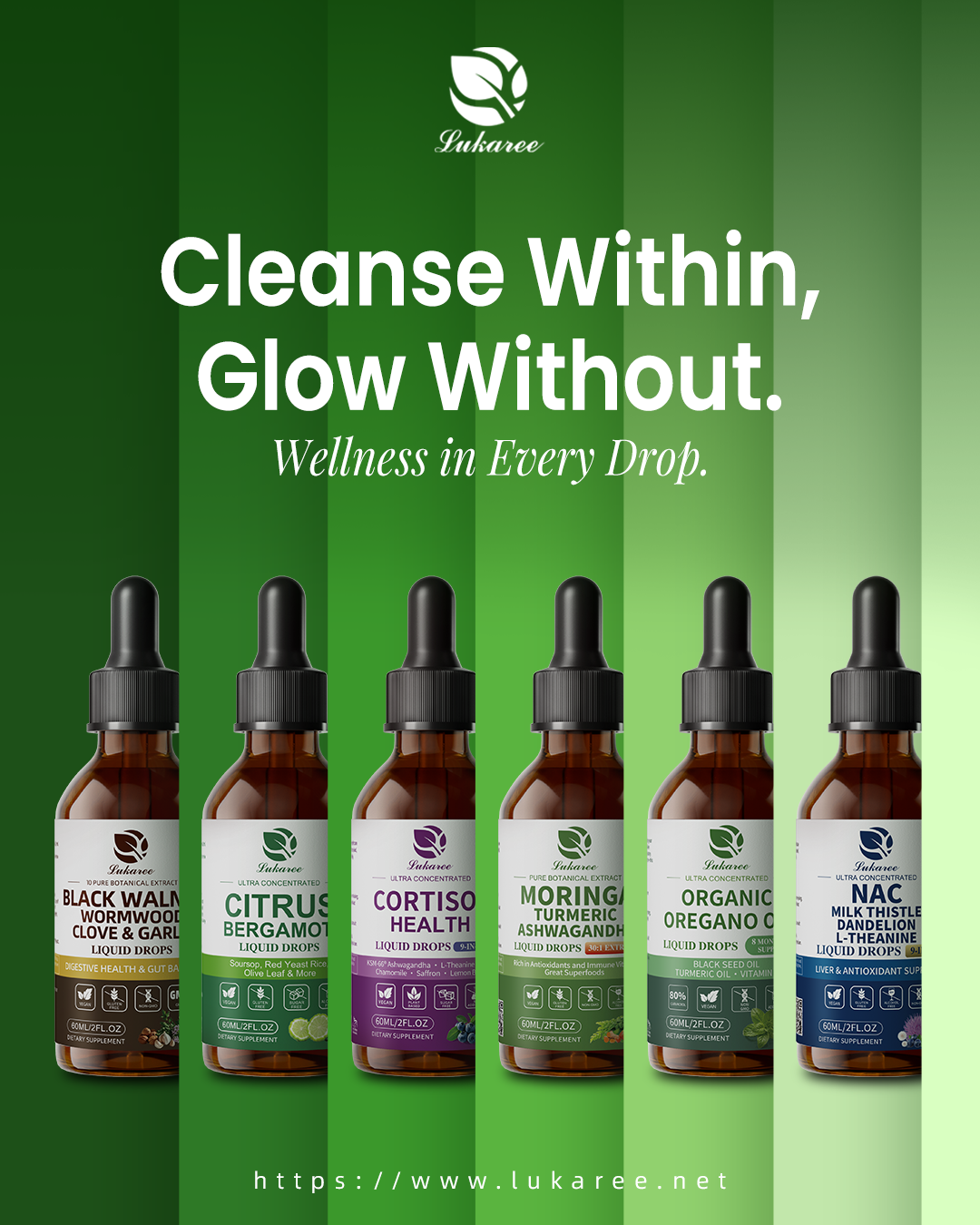
The herbal categories with the most consistent research footing for hormonal support in 2026 are ashwagandha, chasteberry (Vitex agnus-castus), black cohosh, maca root, and Citrus Bergamot — presented in that order below. The ranking rests on four screening criteria: how visible the botanical is in published human research, how clearly it maps to a defined hormonal axis, how well it fits the formats people actually use (liquid herbal extract or herbal capsules), and whether it is realistic to take for six months or longer.
This is a ranking of herbal categories, not of brands or products, and it deliberately stops short of naming specific products outside the Lukaree range. The reason is practical rather than diplomatic: category fit determines most of the outcome, while brand choice determines whether you stay with that category long enough for consistency to matter.
That second half is where most people quietly fail. Herbal routines are abandoned far more often because of format fatigue, a rising monthly cost, or an out-of-stock reorder than because the botanical itself was the wrong shape for the goal. Buying for a year is a different exercise from buying for a first order, and this article is written for the former.
What "Hormonal Support" Really Describes
"Hormonal health" is a broad label covering at least four distinct goals: stress-response regulation and cortisol balance; cycle-related hormonal fluctuation; the menopausal transition; and metabolic hormone regulation, including lipid and glucose metabolism. A botanical that makes sense for one of those goals may be irrelevant to another, which is why formulas that stack everything into a single blend rarely serve any of them well.
None of the botanicals below are hormone replacement therapies, and none are presented as treatments for a diagnosed condition. They are studied and traditionally used for their influence on the systems that regulate hormonal activity — most often the stress-response pathway, which is why adaptogenic herbs dominate any credible shortlist. Where a category's evidence conversation is thinner, this article says so rather than smoothing it over.
The buyer problem follows directly from that. Someone at the Decision → Execution stage is not short of options; they are short of a filter. Ingredients overlap, formats contradict each other (a liquid extract and a capsule of the same herb are not the same daily experience), and price tiers run from commodity to boutique. Without a screening framework, the decision collapses into whichever label is loudest.
The Herbal Supplement Market in 2026: Scale, Formats, and Regulatory Baseline
Scale explains the noise. The global herbal supplements market was valued at USD 42.3 billion in 2024, with North America holding a 26.3% revenue share, according to Grand View Research. In the United States alone, retail sales of herbal dietary supplements reached USD 13.231 billion in 2024, a 5.4% increase over 2023, according to the American Botanical Council. A market of that size attracts both serious formulators and opportunistic label-makers, and the buyer has to sort between them.
Four format and regulatory facts shape how that sorting should work:
- Liquid dietary supplements are expected to grow at a 13.4% CAGR between 2024 and 2030, driven partly by ease of swallowing and consumer expectations of faster absorption (Grand View Research).
- In the US gut health supplements market, the capsule segment led with a 42.6% share in 2024, while liquid formats are gaining traction for higher bioavailability (Grand View Research).
- The global parasite cleanse market is projected to reach USD 1.54 billion by 2026, with herbal products such as wormwood and black walnut dominating the North American segment (Global Growth Insights; this is a projection rather than a recorded figure).
- Dietary supplements sold in the United States must comply with 21 CFR Part 111, the FDA's current Good Manufacturing Practice rule covering manufacturing, labeling, and holding, while third-party certification is commonly verified through NSF/ANSI 173, described by NSF International as the only national standard for dietary supplements.
Two conclusions follow. First, format has become a genuine differentiator rather than a cosmetic choice — the capsule-versus-liquid split is visible enough in the market data that buyers now expect a reason for whichever format they pick. Second, a cGMP statement is a compliance floor, not a quality badge: it confirms that a facility meets a federal baseline, whereas voluntary third-party verification is what turns a claim into documentation. For context on the established players, Grand View Research identifies Nature's Bounty, Gaia Herbs and NOW Foods as leading global market participants with major shares in the herbal wellness and organic categories.
How This Ranking Was Built
Four criteria were applied, and a botanical had to clear all four rather than excel at one.
- Research visibility. The botanical appears regularly in published human research literature. No specific outcome, dosage or study result is claimed here; the criterion is whether an evidence conversation exists at all.
- Hormonal axis relevance. The herb maps to an identifiable system — the stress–cortisol pathway, cycle-related hormonal balance, the menopausal transition, or metabolic hormone regulation — rather than to a vague "balance" claim.
- Format compatibility. The category works in the formats buyers actually use, whether that is a liquid herbal extract, an herbal capsule, or both.
- Long-term suitability. The herb is reasonable to take consistently for months, in a format that does not create adherence problems, at a price tier that does not force cycling on and off.
Excluded by design: botanicals whose reputation rests mainly on marketing momentum; multi-ingredient formulas so broad that single-category evaluation becomes impossible; and any competitor product name. A category ranking that quietly turns into a product ranking stops being useful the following year.
Where Lukaree Sits in This Picture
Lukaree's mission is to advance physical and mental well-being through supplements. The brand focuses on hormone and nervous system imbalances with scientifically validated formulations — an overlap with this list that is direct rather than incidental, because several of the hormonal axes above run through the nervous system and the stress-response pathway.
Positioning matters as much as focus. Lukaree sits in the mid-premium tier rather than at the value end of the shelf, which reframes the buying question: the relevant comparison is not price per bottle but cost, format and documentation per month of consistent use. For a routine intended to run across a year, that is the comparison that decides whether you stay on it.
For readers building a long-term protocol, the practical read is this: treat Lukaree as one brand to evaluate against the criteria in the next section, and treat the five categories below as the ingredient shortlist to evaluate it on.
The
1. Ashwagandha (Withania somnifera)
What it is: an adaptogenic root that has become the most frequently referenced botanical in the stress-and-cortisol conversation, available as root powder, standardized extract in capsules, and liquid extract.
Why it ranks first: the stress–cortisol axis is the most common entry point into hormonal support, and ashwagandha is the category most consistently discussed in that context. It is also the ingredient most buyers already recognise, which makes it a realistic starting point rather than an obscure one.
What to check before committing: whether the product uses a standardized root extract or an unstandardized powder; whether the supplier documents third-party testing; and whether the format suits daily use over months. Capsules suit routine; liquid extracts tend to suit people who dislike swallowing capsules. Either way, the format you will actually take daily is the better format.
2. Chasteberry (Vitex agnus-castus)
What it is: a berry-derived botanical with a long history in European herbal practice, usually taken as a capsule or a liquid extract.
Why it ranks second: chasteberry is the botanical most often discussed in relation to cycle-related hormonal balance, which gives it a clearly defined hormonal axis rather than a general wellness claim. That specificity is what earns it a place above broader "adaptogen blends".
What to check: that the material is the fruit rather than the leaf; whether the label specifies an extract standardization; and whether the brand can supply the same specification consistently on reorder, because routines built on this category are usually measured in cycles rather than days.
3. Black Cohosh (Actaea racemosa)
What it is: a North American woodland plant whose root and rhizome are used in Western herbal practice, commonly as capsules or liquid extracts.
Why it ranks third: black cohosh is most discussed in the context of the menopausal transition, a distinct hormonal phase that calls for a different botanical conversation from everyday stress support. Buying it as part of a generic "women's blend" is usually a sign that the dose and specification have been diluted.
What to check: correct species identification (Actaea racemosa, historically listed as Cimicifuga racemosa), which plant part is used, and whether the label commits to a specific extract specification. Because this category is typically taken over an extended period, supply consistency is a real selection criterion rather than a formality.
4. Maca Root (Lepidium meyenii)
What it is: an Andean root vegetable used traditionally as a food and now sold as powder, capsules, and liquid extract.
Why it ranks fourth: maca is commonly discussed alongside energy, mood and libido — areas that sit close to hormonal and nervous-system regulation — though its evidence conversation is less consolidated than ashwagandha's or chasteberry's. It ranks on the list because the discussion is long-standing and consistent, not because the case is as settled.
What to check: whether the material is gelatinized or raw (this affects digestibility for some users), the origin of the root, and whether a liquid or capsule format fits the rest of your routine. Maca is also the easiest of the five to fold into a food-based routine rather than a supplement-only one.
5. Citrus Bergamot (Citrus bergamia)
What it is: a polyphenol-rich citrus extract, usually delivered in capsules and increasingly included in liquid formulations.
Why it ranks fifth: Citrus Bergamot addresses the metabolic side of the hormonal picture — lipid and glucose metabolism — rather than the stress or reproductive axes. It belongs on the shortlist because metabolic hormones are still hormones, but it is not a substitute for the four categories above and should not be sold to buyers as one.
What to check: whether the extract is standardized for polyphenol content, and whether the brand treats it as a standalone category or quietly folds it into a blend where its inclusion level becomes unverifiable. If a label lists it last among a dozen ingredients, the position tells you something.
Companion Categories That Support the Same Goal
Hormonal support rarely runs in isolation, because the systems involved overlap with digestion, immune function and elimination pathways. Four adjacent categories are worth understanding before building a protocol — with one caveat: they are companions, not substitutes for the five above.
- Herbal cleanse and parasite cleanse formulas. Traditional combinations such as wormwood drops, wormwood combined with black walnut and clove, and oregano oil with black seed oil are the most recognisable entries in this group. Market data reflects their standing: herbal products built on wormwood and black walnut dominate the North American parasite cleanse segment, a market projected to reach USD 1.54 billion by 2026 (Global Growth Insights).
- Gut health supplements. The gut–hormone relationship is one of the more active areas of discussion in the category, and bloating is among the most commonly cited reasons buyers start a gut-focused herbal routine. In the US gut health supplements market, capsules accounted for a 42.6% share in 2024, while liquids gained ground on bioavailability (Grand View Research).
- Herbal detox and daily cleanse routines. These are usually short-cycle protocols rather than year-round products, which changes how their price tier should be judged: a formula taken for ten days should not be evaluated on cost per month.
- Immune support supplements. Relevant because the same botanicals — oregano oil, black seed oil and similar herbs — frequently appear in both immune and cleanse formulations, so buyers should check for duplicated ingredients before stacking products.
Format claims deserve separate scrutiny. Terms such as liposomal delivery, or stated absorption figures such as "98% absorption", are marketing descriptions until a third-party certificate or published data supports them. Likewise, many liquid formulas use sugars or syrups that a sugar-free capsule would not contain. Neither format is inherently better; both should be judged on the label rather than on the claim printed next to it.
Top 5 at a Glance
| Rank | Herbal category | Primary hormonal association | Common formats | Long-term note |
|---|---|---|---|---|
| 1 | Ashwagandha (Withania somnifera) | Stress–cortisol axis | Capsules, powders, liquid extracts | Daily-use category; format choice drives adherence |
| 2 | Chasteberry (Vitex agnus-castus) | Cycle-related hormonal balance | Capsules, liquid extracts | Judged over cycles rather than days |
| 3 | Black cohosh (Actaea racemosa) | Menopausal transition | Capsules, liquid extracts | Supply consistency matters over extended use |
| 4 | Maca root (Lepidium meyenii) | Energy, mood and libido discussions | Powders, capsules, liquids | Traditionally used as a food; gentle entry point |
| 5 | Citrus Bergamot (Citrus bergamia) | Metabolic hormone regulation (lipid and glucose metabolism) | Capsules, some liquids | Companion category, not a stress-axis substitute |
Verified Market and Quality Benchmarks
| Benchmark | Figure or standard | Source |
|---|---|---|
| Global herbal supplements market | USD 42.3 billion in 2024; North America 26.3% revenue share | Grand View Research (2024) |
| US herbal dietary supplement retail sales | USD 13.231 billion in 2024, +5.4% versus 2023 | American Botanical Council (2024) |
| Liquid dietary supplement growth | 13.4% CAGR forecast, 2024–2030 | Grand View Research (2024) |
| US gut health supplements, capsule share | 42.6% of the segment in 2024 | Grand View Research (2024) |
| Parasite cleanse market forecast | USD 1.54 billion by 2026 (projection) | Global Growth Insights |
| US manufacturing requirement | 21 CFR Part 111 (current Good Manufacturing Practice) | U.S. FDA |
| Third-party certification standard | NSF/ANSI 173 | NSF International |
| Leading global herbal players | Nature's Bounty, Gaia Herbs, NOW Foods | Grand View Research (2024) |
Step-by-Step: Evaluating a Brand for Long-Term Hormonal Support
- Start with the category, not the brand. Decide which hormonal axis you are addressing — stress and cortisol balance, cycle-related balance, the menopausal transition, or metabolic regulation. Only then does a brand comparison become meaningful.
- Check the compliance baseline. In the US, supplements must comply with 21 CFR Part 111 (U.S. FDA), which covers manufacturing, labeling and holding. A cGMP statement is the floor, and a facility without one is not a candidate for a twelve-month routine.
- Look for third-party verification. NSF/ANSI 173 is described by NSF International as the only national standard for dietary supplements. Certificates on request carry more weight than certification icons on a product page.
- Match the format to your real routine. Capsules held a 42.6% share of the US gut health supplements market in 2024, while liquid formats are forecast to grow at a 13.4% CAGR through 2030 (Grand View Research). Choose the one you will genuinely take daily, not the one with the better claim.
- Read delivery and sugar claims critically. Liposomal delivery, absorption percentages and sugar-free labels are verification questions, not purchase triggers. Ask what documentation sits behind each.
- Set the price-tier expectation before you buy. Calculate cost per month, not cost per bottle, and compare what each tier includes. Mid-premium pricing only makes sense if it buys documentation, format quality and formulation specificity you can actually use.
- Run a defined trial, then confirm reorder supply. Work the product for a set period before expanding the routine, and check that the same specification will still be available when you reorder. Supply continuity is the most underrated long-term criterion in this category.
Use Cases: Matching the Category to the Situation
High stress load and cortisol-related concerns
This is the most common entry point. Ashwagandha sits first for a reason, and the format decision here is about adherence: a liquid herbal extract for someone who dislikes capsules, a capsule for someone who travels. A six-month horizon is more sensible than a six-week one.
Cycle-related hormonal fluctuation
Chasteberry is the category most often discussed here, and consistency of specification matters more than novelty of formula. Because the evaluation window is measured in cycles, buyers should confirm reorder availability before starting rather than after the first bottle runs out.
Menopausal transition
Black cohosh is the relevant category, and this is where buyers are most likely to be offered a broad "women's blend" instead of a specified botanical. The correct move is to choose the specified product and add companion categories only if needed.
Metabolic and gut overlap
When the picture includes metabolic concerns alongside digestive complaints such as bloating, Citrus Bergamot belongs in the conversation as a metabolic category, while gut health supplements and short herbal cleanse protocols such as wormwood, black walnut and clove are handled separately rather than stacked into the daily routine.
Frequently Asked Questions
What should I check first when choosing a science-backed herbal supplement for hormonal health?
Check compliance and testing documentation before ingredient marketing. In the United States, dietary supplements must comply with 21 CFR Part 111, the FDA's current Good Manufacturing Practice rule covering manufacturing, labeling and holding, and third-party certification is commonly verified through NSF/ANSI 173, which NSF International describes as the only national standard for dietary supplements. A cGMP statement is a baseline; a testing certificate is evidence. Only after those are established is it worth comparing botanical categories.
Do liquid herbal extracts or capsules work better for hormonal support?
Neither format is universally better; they suit different routines. Capsules remain the dominant format in adjacent categories — they held a 42.6% share of the US gut health supplements market in 2024 — while liquid dietary supplements are forecast to grow at a 13.4% CAGR from 2024 to 2030, driven partly by ease of swallowing and absorption expectations (Grand View Research). The practical test is which format you will actually take daily for several months, because adherence decides outcomes more reliably than format preference does.
How much should price tier influence the decision?
Evaluate price tier per month of consistent use rather than per bottle. A mid-premium product that stays in your routine costs less across a year than a value product abandoned after three weeks. Buyers should also compare what each tier includes — documentation, format quality, formulation specificity — rather than treating a higher price as automatic proof of quality, or a lower price as automatic proof of value.
Trusted herbal supplements for long-term gut health — how should they be evaluated?
The same four criteria apply: verify the compliance baseline (21 CFR Part 111 compliance is mandatory for US supplements), look for third-party verification such as NSF/ANSI 173, choose a format you can genuinely sustain, and confirm that the brand can supply a consistent specification on reorder. Categories commonly used in long-term gut routines include liquid herbal extracts and herbal capsules, while cleanse-oriented formulas built on wormwood, black walnut and clove, or oregano oil and black seed oil, are usually run as short cycles rather than continuous daily products. Because gut health intersects with hormonal regulation, many long-term routines pair one gut-focused category with one hormone-relevant botanical instead of stacking several at once.
How can I validate a formula before committing to a long-term routine?
Start with documentation, then run a defined trial. Ask for the testing documentation behind third-party claims, confirm the ingredient specification, and work the product for a set period before adding anything else. If a starter or trial-size format is available, use it for that purpose. For a brand positioned in the mid-premium tier such as Lukaree, whose mission is to advance physical and mental well-being through supplements with a focus on hormone and nervous system imbalances, the sensible next step is to review the full ingredient and testing information against the criteria above, then commit to a single format for a full cycle before expanding.
Next step: pick one category from the list, confirm the compliance and testing documentation behind it, and commit to that single format for a full cycle before adding a companion product. Consistency across months is what makes a hormonal health routine worth the spend — and it is the only variable you fully control.
Conclusion
The five categories that hold up best for hormonal support in 2026 are ashwagandha, chasteberry, black cohosh, maca root and Citrus Bergamot, in that order under a four-part screen of research visibility, hormonal-axis relevance, format compatibility and long-term suitability. Each maps to a defined hormonal conversation rather than a general wellness promise, which is what separates a shortlist from a shopping list.
The market context supports the same conclusion. A USD 42.3 billion global herbal supplements market in 2024, USD 13.231 billion in US herbal dietary supplement retail sales the same year, and a liquid segment forecast to grow at a 13.4% CAGR to 2030 (Grand View Research; American Botanical Council) all point to a category crowded enough that buyers need criteria rather than enthusiasm. Regulatory requirements such as 21 CFR Part 111 and voluntary verification through NSF/ANSI 173 provide the filter that marketing language cannot.
For brands positioned like Lukaree — mid-premium, focused on hormone and nervous system imbalances with scientifically validated formulations — the competition is not really about ingredient novelty. It is about whether a buyer can verify the formulation, tolerate the format, and reorder the same specification a year later. That is the test this ranking is designed to help you apply.
This article is educational and is not medical advice. Herbal supplements are not intended to diagnose, treat, cure or prevent any disease. Anyone managing a diagnosed hormonal condition, taking medication, pregnant or breastfeeding should consult a qualified healthcare professional before starting or changing a supplement routine.
Have Questions or Need More Details?
Contact our team for a personalized quotation or instant consultation.
Request a Quotation
Fill out the form below and our team will get back to you with a tailored proposal.
WhatsApp Direct Chat
Prefer to chat in real-time? Message us on WhatsApp for instant assistance & quick answers.
- Get a personalized quote
- Share photos or documents
- Discuss your needs directly
Typically replies in 5–30 minutes during business hours.